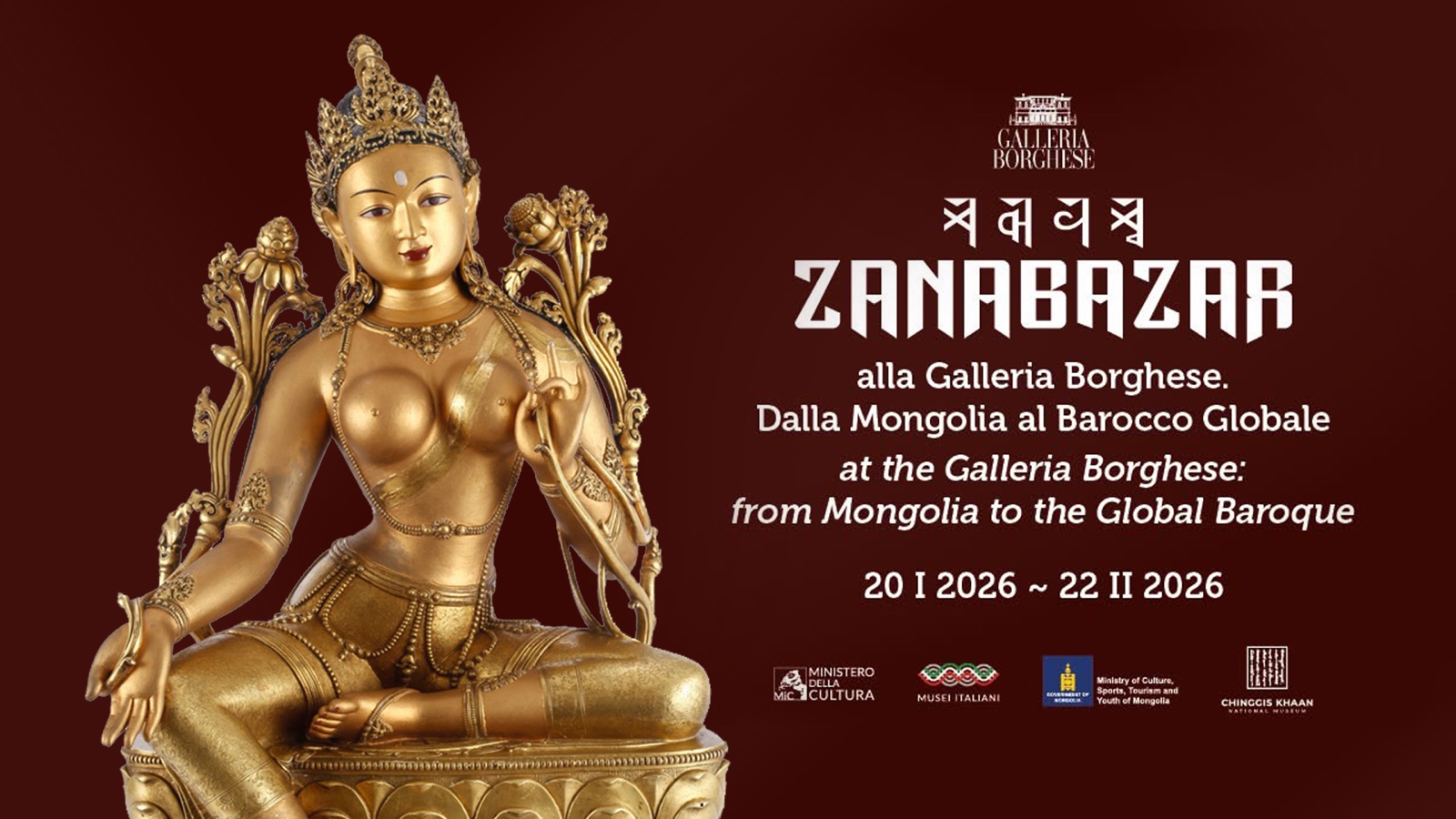
"ZANABAZAR: From Mongolia to Global Baroque" Special Exhibition
Co-organizer: Tsendiin Gan-Erdene
Born in the heart of the Asian steppe, home to one of the largest empires in human history, Eshidorj was a nobleman descended from the Golden Lineage of Chinggis Khan. He came to be widely known by his religious name, Zanabazar, and was honored with the title "Undur Gegeen" (the High Saint). As the head of the Gelugpa tradition of Tibetan Buddhism in Mongolia, the First Bogd Jebtsundamba Khutuktu, he was venerated as the reincarnation of one of the original five hundred disciples of the Buddha. An exceptional spiritual leader, Undur Gegeen Zanabazar was not only an outstanding scholar of linguistics but also the greatest sculptor of early modern Mongolia. The profound knowledge and inspiration he gathered while studying in the monasteries of Tibet and during his travels permeate the works created by him and his disciples, and these have been preserved as sacred objects of devotion in the temples and monasteries he founded across Mongolia. Among them, his images of the Holy Tara stand out for their supreme aesthetic value. Tara is the female embodiment of the Buddha, symbolizing salvation, compassion, liberation, and inner peace of the soul. Zanabazar spread Buddhism throughout Mongolia on an unprecedented scale and made it comprehensible to the ordinary faithful. His aim was to create sculptures that could communicate directly with the human eye and heart, sculptures that were, as Mongolians say, "warm to the eye" and possessed of a perfect natural harmony. Bernini in Europe and Zanabazar in Asia each left an indelible mark upon their own cultures. Both developed innovative visions and unprecedented methods for reinterpreting traditional subjects and themes, opening a new language of art, and the models they created exerted a profound influence on the generations that followed. They belonged to two distant and different worlds, yet each possessed the creative power to transform the history of art.
The works presented in this exhibition, an exquisitely crafted Green Tara and a gilded bronze sculpture bearing a portrait of Zanabazar himself, have come from the Chinggis Khaan National Museum in Ulaanbaatar. Through their interrelationship and juxtaposition, his work is being presented to the public for the first time in history in Europe, and above all in Italy. For visitors to this Western museum, these works offer a vivid opportunity to see and appreciate the differences between the art and culture of East and West in terms of aesthetics and form, and to bear witness to a new and shared cultural future.
This project grew out of the exhibition "Global Baroque: The World in Rome at the Time of Bernini" (4 April to 13 July 2025). That exhibition highlighted the profoundly intercultural character of seventeenth-century Rome and showed how trade and commerce, diplomatic relations, and the travels of artists and religious figures formed the dense network of connections that laid the foundations of present-day globalization.
Though the Galleria Borghese may seem a world utterly apart in history, geography, and technique, this unprecedented and singular project examines the intricate relationships between the imagery and artifacts of two different regions that were nonetheless remarkably close in their creative thinking and in their power to shape the future of art. This is the very soul of the "global baroque" and an unrivaled opportunity for the public. Above all, it is distinguished by allowing visitors to view in a single place works that are preserved tens of thousands of kilometers apart, presenting the finest masterpieces of art that became the expression of one historical era.